

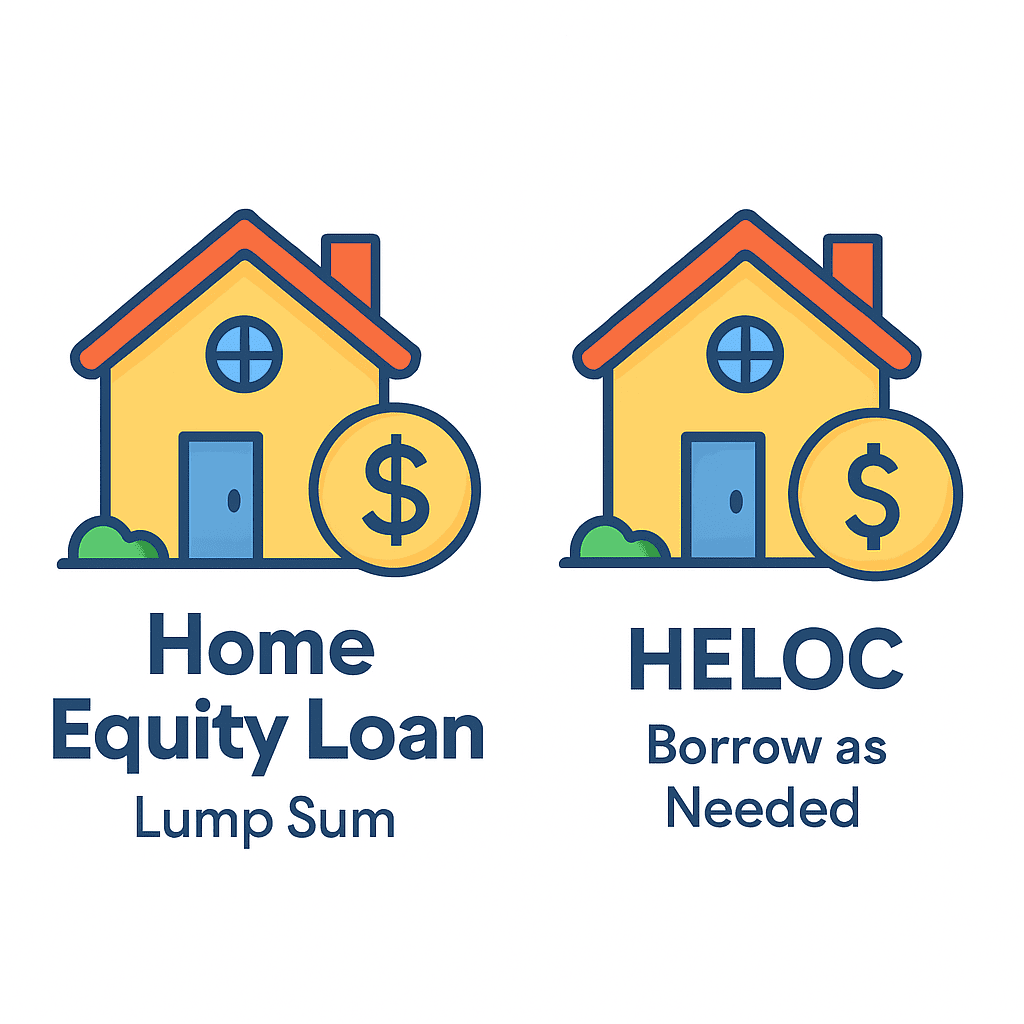
Are you thinking about using your home to borrow money? Many homeowners face this choice. Home equity vs. HELOC is a big decision. Both let you use the value in your home to get cash. But they work very differently. This guide will help you understand both options. By the end, you’ll know which one fits your needs best.
What Is Home Equity?
Before we talk about home equity vs. HELOC, let’s explain home equity. Home equity is the part of your home that you really own.
Here’s how it works. Let’s say your home is worth $300,000. You still owe $200,000 on your mortgage. Your home equity is $100,000. That’s $300,000 minus $200,000.
The more you pay off your mortgage, the more equity you have. When your home’s value goes up, your equity grows too.
What Is a Home Equity Loan?
A home equity loan is like a second mortgage. You borrow a fixed amount of money all at once. You get it in one big lump sum.
How Home Equity Loans Work
You apply for a specific amount. The bank approves you. Then they give you all the money at closing.
You pay it back every month. Your payment stays the same each month. You have a fixed interest rate. That means your rate never changes.
Most home equity loans last 5 to 30 years.
Pros of Home Equity Loans
Home equity loans have some great benefits:
- Fixed payments: You always know what you’ll pay each month
- Fixed interest rate: Your rate never goes up
- Get all the money at once: Perfect for big projects
- Lower rates than credit cards: Much cheaper than plastic
- Easy to budget: Same payment makes planning simple
Cons of Home Equity Loans
But there are downsides too:
- Your home is at risk: If you can’t pay, you could lose your house
- Closing costs: You might pay $500 to $5,000 in fees
- Less flexible: You can’t borrow more later without a new loan
- Fixed amount: You might borrow more than you actually need
What Is a HELOC?
A HELOC stands for Home Equity Line of Credit. It works more like a credit card. You get a credit limit instead of a lump sum.
How HELOCs Work in Home Equity vs. HELOC Comparison
Think of a HELOC like a credit card tied to your house. The bank approves you for a maximum amount. But you don’t have to take it all.
You can borrow what you need, when you need it. You only pay interest on what you actually borrow.
HELOCs have two phases:
- Draw period: Usually 5-10 years when you can borrow money
- Repayment period: Usually 10-20 years when you pay it all back
Pros of HELOCs in Home Equity vs. HELOC Choices
HELOCs offer great flexibility:
- Borrow only what you need: Don’t take more than necessary
- Pay interest only on what you use: Save money
- Reuse the money: As you pay it back, you can borrow again during the draw period
- Good for ongoing projects: Perfect if you need money at different times
- Lower initial payments: During the draw period, you might only pay interest
Cons of HELOCs in Home Equity vs. HELOC Scenarios
But HELOCs have risks too:
- Variable interest rate: Your rate can go up
- Payments can increase: Your monthly bill might get bigger
- Temptation to overspend: Easy access can lead to debt
- Your home is at risk: Just like home equity loans
- Payment shock: When the draw period ends, payments jump up
Home Equity vs. HELOC: Key Differences
Let’s compare them side by side:
Payment Structure in Home Equity vs. HELOC
Home equity loan: Fixed monthly payments from day one.
HELOC: Flexible payments during the draw period. Usually interest-only at first. Then bigger payments later.
How Interest Rates Compare: Home Equity vs. HELOC
Home equity loan: Fixed rate that never changes.
HELOC: Variable rate that can go up or down. It usually follows the prime rate.
How You Get the Money in Home Equity vs. HELOC
Home equity loan: All at once in a lump sum.
HELOC: Withdraw money as you need it, up to your limit.
Best Uses for Home Equity vs. HELOC
Home equity loan: Big one-time expenses. Like a major home renovation. Or paying off high-interest debt.
HELOC: Ongoing expenses. Like a long remodeling project. Or college tuition paid over several years.
When to Choose a Home Equity Loan
A home equity loan works best when:
- You need all the money right away
- You want predictable monthly payments
- You prefer a fixed interest rate
- You’re doing a big one-time project
- You want to consolidate debt
- You like knowing exactly what you’ll pay
Good Projects for Home Equity Loans
These projects are perfect for home equity loans:
- Kitchen remodel
- Bathroom renovation
- New roof
- Room addition
- Paying off credit cards
- Medical bills
- Wedding expenses
When to Choose a HELOC
A HELOC works best when:
- You need money at different times
- You’re not sure exactly how much you’ll need
- You want flexibility
- You can handle payment changes
- You’re doing a project in phases
- You want a financial safety net
Good Projects for HELOCs
These situations fit HELOCs well:
- Long renovation projects
- College tuition over four years
- Starting a business
- Emergency fund backup
- Ongoing medical treatments
- Multiple small projects
Understanding Interest Rates in Home Equity vs. HELOC Options
Interest rates are really important. They determine how much you’ll really pay.
Fixed vs. Variable Rates in Home Equity vs. HELOC
Home equity loans have fixed rates. If you get 7%, you keep 7% forever. This makes budgeting easy.
HELOCs have variable rates. Your rate changes based on the market. If rates go up, you pay more. If rates go down, you pay less.
Current Rate Trends
Right now, rates depend on many things. Your credit score matters a lot. Your home’s value matters too. How much equity you have makes a difference.
Generally, home equity loan rates are a bit higher than first mortgage rates. HELOC rates can start lower but might increase.
How Much Can You Borrow with Home Equity vs. HELOC?
Most banks let you borrow up to 80-85% of your home’s value. But you have to subtract what you still owe on your mortgage.
The Math
Here’s an example:
- Home value: $400,000
- Mortgage balance: $250,000
- Maximum you can borrow: 85% of $400,000 = $340,000
- Subtract mortgage: $340,000 – $250,000 = $90,000
You could borrow up to $90,000.
Qualifying for Home Equity vs. HELOC
Banks look at several things when you apply.
Credit Score Requirements for Home Equity vs. HELOC
You usually need a credit score of at least 620. But better scores get better rates. A score of 740 or higher gets you the best deals.
Income and Debt
Banks check how much money you make. They look at all your debts too. Your debt payments shouldn’t be more than 43% of your income.
Home Value
Your home needs to be worth enough. Banks might require a new appraisal. You might have to pay for this.
Costs and Fees in Home Equity vs. HELOC
Both options come with costs.
Home Equity Loan Costs
You might pay:
- Application fee
- Appraisal fee ($300-$500)
- Origination fee (1-2% of the loan)
- Closing costs (similar to a mortgage)
- Title search and insurance
Total costs might be $1,000-$5,000 or more.
HELOC Costs
HELOCs often have lower upfront costs:
- Application fee (sometimes waived)
- Appraisal fee
- Annual fee ($50-$100)
- Inactivity fee (if you don’t use it)
- Early closure fee
Some banks offer no-cost HELOCs. But you might pay a higher interest rate.
Tax Benefits for Home Equity vs. HELOC
The tax rules changed in 2018.
When You Can Deduct Interest
You can only deduct the interest if you use the money to “buy, build, or substantially improve” your home.
If you use the money for other things, you can’t deduct the interest. This applies to both home equity loans and HELOCs.
Always talk to a tax professional about your situation.
Risks of Borrowing: Home Equity vs. HELOC Realities
Both options use your home as collateral. This means there are serious risks.
You Could Lose Your Home
If you can’t make payments, the bank can foreclose. You could lose your house. This is the biggest risk.
Owing More Than Your Home Is Worth
If home values drop, you might owe more than your home is worth. This is called being “underwater.” It makes selling your home very hard.
Debt Can Grow with Home Equity vs. HELOC
With HELOCs especially, it’s easy to keep borrowing. You might end up with more debt than you can handle.
Alternatives to Home Equity vs. HELOC
Before choosing between home equity vs. HELOC, consider other options.
Personal Loans
Personal loans don’t use your home as collateral. They have higher interest rates. But your home is safe if you can’t pay.
Credit Cards
For smaller amounts, credit cards might work. Some have 0% intro rates. But regular credit card rates are very high.
Cash-Out Refinance
You could refinance your whole mortgage for a bigger amount. You take the difference in cash. This might make sense if current mortgage rates are good.
401(k) Loans
You might be able to borrow from your retirement account. But this can hurt your retirement savings.
Making Your Decision on Home Equity vs. HELOC
Now you understand home equity vs. HELOC. How do you choose?
Ask Yourself These Questions
- Do I need all the money at once?
- Am I comfortable with changing payments?
- Do I want a fixed interest rate?
- How much flexibility do I need?
- What’s my credit score?
- Can I afford the payments if rates go up?
- Am I using the money to improve my home?
Talk to Multiple Lenders About Home Equity vs. HELOC
Don’t just go with your current bank. Shop around. Compare rates and terms. Ask about fees.
Get quotes from at least three lenders. This helps you find the best deal.
Consider Your Financial Situation
Be honest about your finances. Can you really afford the payments? What if rates go up? What if you lose your job?
Only borrow what you truly need. And make sure you can pay it back.
Tips for Using Home Equity Wisely
If you decide to tap your home equity, be smart about it.
Use It for Good Reasons
The best uses add value to your life:
- Home improvements that increase your home’s value
- Paying off high-interest debt
- Education that leads to better income
- Emergency expenses
Avoid These Mistakes
Don’t use home equity for:
- Vacations
- Fancy cars
- Everyday expenses
- Risky investments
- Things you don’t really need
Have a Repayment Plan
Before you borrow, know how you’ll pay it back. Make a budget. Stick to it.
Set up automatic payments so you never miss one.
The Bottom Line on Home Equity vs. HELOC
Both home equity vs. HELOC options can help you access your home’s value. But they work differently.
Choose a home equity loan if you want:
- Fixed payments
- A fixed interest rate
- All the money at once
- Simple budgeting
Choose a HELOC if you want:
- Flexibility
- To borrow only what you need
- Access to money over time
- Lower initial payments
Remember, both put your home at risk. Borrow responsibly. Only take what you need. And always make your payments on time.
Your home is probably your biggest asset. Treat it with care. Make the choice that’s right for your situation. And don’t be afraid to ask for help from a financial advisor.
Now you’re ready to make a smart decision about home equity vs. HELOC!
Read our other articles: Clarksville Property Value Appreciation Over the Last Decade or Exterior Paint Colors That Increase Home Value
Ready to Buy or Sell? We’re Here to Help!
Browse our listings: www.buyclarksvillehomes.com
Phone: (931) 320-6987
Email: joey@williamsonhg.org
Website: buyclarksvillehomes.com
Each Keller Williams office is independently owned and operated.